

Social Impact Fund
Ireland's new gambling law makes licensed operators pay into a fund for treatment, research and awareness of gambling harm. Here is how it works, where it stands in 2026 and what it changes for you as a player.
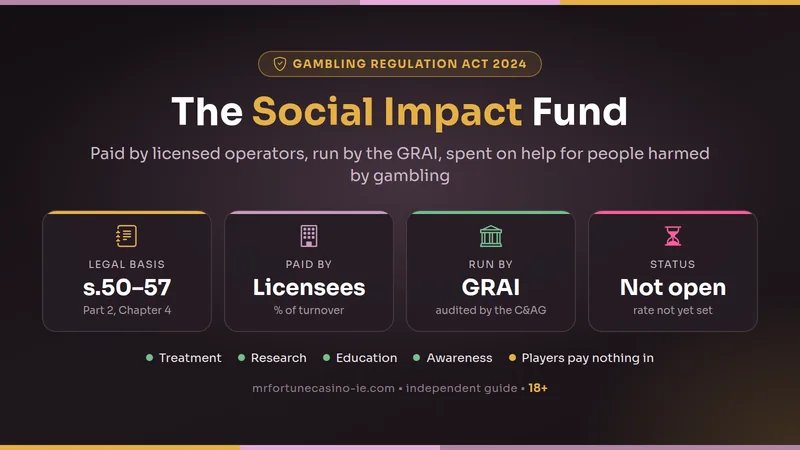
- Legal basisSections 50–57Gambling Regulation Act 2024
- Paid byLicensees% of turnover, set by the Minister
- StatusNot open yetas of September 2026
- Managed by the GRAI
- Audited by the C&AG
- Players pay nothing into it
What to do with this information
- 1
Know who pays — The contribution is a cost of the operator's licence. Nothing is added to your deposits, stakes or withdrawals because of it, and no casino can legitimately charge you a "Social Impact Fund fee".
- 2
Check who licenses the site you use — The fund only applies to companies holding a licence from the GRAI. Online casinos, including Mr Fortune, cannot get an Irish licence yet and run on foreign licences instead; you can see Mr Fortune's on the MGA public register.
- 3
Don't leave money sitting in old accounts — Under the same Act, an Irish-licensed operator must close an account that has been inactive for 13 months, try to refund you, and send any balance it cannot return to the fund. Withdraw what you have before you stop playing.
- 4
Use the help that exists today — You do not need to wait for the fund. Free support is already available from Gambling Care and Problem Gambling Ireland, and your casino account has limit and self-exclusion tools right now.
- 5
Watch for the opening call — If you work for a charity or a treatment service, the GRAI will publish its invitation, criteria and payment terms on its website when the fund opens.
Sources we checked
Everything on this page comes from the text of the Act and from the regulator's own pages, read on 22 September 2026. Trade press is used only for the date of the first consultation.
- Gambling Regulation Act 2024 (No. 35 of 2024) — Part 2, Chapter 4, sections 50 to 57, and section 171 on closing inactive accounts.
- GRAI — Social Impact Fund: What is it? — what the fund will invest in and how the contribution is raised.
- GRAI — Who can apply? — confirms the fund is not yet open and lists the eligible areas.
- GRAI — Funding Strategy — the needs assessment the regulator has asked Pobal to lead.
- iGaming Business, 22 April 2025 — report on the GRAI's call for input on the fund.
What it means for you as a player
For most people who play at an online casino from Ireland, the honest answer is: not much yet, and nothing that costs you money. The fund changes where the industry's money goes, not what you pay. Still, a few parts of it touch players directly, and one of them is worth knowing before you walk away from an old account.
- No extra charge on your play — The Act puts the contribution on the licensee. It is calculated on the operator's turnover and paid to the GRAI once a year; there is no line for it in your cashier.
- Dormant balances have a destination — An Irish-licensed operator must close an account after 13 months without play (unless you are on the exclusion register), make reasonable efforts to refund you, and only then transfer the money to the fund.
- That money is still yours — If you turn up later, the operator directs you to the GRAI, which must refund you within 28 days of your request. The fund never gets to keep it for good.
- Better-funded help services — The point of the fund is money for treatment, counselling, community projects and research, so more services and shorter waiting lists are the benefit you are most likely to notice.
- Offshore sites sit outside it — A casino without a GRAI licence pays nothing into the fund and is not bound by section 171. Mr Fortune is licensed in Malta, and its own terms charge €5 a month on accounts idle for 12 months instead.
- Beware of anyone asking you for a "levy" — The fund is never collected from players. A message asking you to pay a Social Impact Fund charge before a withdrawal is a scam.
What the law actually says
The fund sits in Part 2, Chapter 4 of the Gambling Regulation Act 2024, sections 50 to 57. Section 50 tells the GRAI to set up and maintain a fund "known as the Social Impact Fund", managed and controlled by the Authority itself rather than by a government department or by the industry.
Section 51 lists what the money can be spent on. In plain terms: research, training and community projects aimed at reducing compulsive or excessive gambling; public education and awareness campaigns, including telling people where help is available; treatment services for people who gamble compulsively and for those affected by someone else's gambling, such as family members; and cooperation with researchers abroad where the work benefits people in Ireland.
The GRAI can invite proposals and applications. When it does, it has to publish the criteria it will use and how payments will be made. Anyone who gets money has to keep accounts of how it was spent, submit them by 1 March of the following year, follow any conditions attached to the grant and report on request. Ignoring those duties is an offence, with penalties up to a fine and five years in prison on indictment.
Section 54 is the funding clause. Every licensee except charity and philanthropic licence holders pays an annual contribution. The Minister for Justice makes regulations setting the percentage of turnover that is payable and how and when it is paid, possibly in instalments. The GRAI then sends each licensee a notice with its amount and deadline, and can sue for unpaid contributions as a simple debt.
The rest is housekeeping with teeth: the Minister can authorise payments from the fund to cover the GRAI's cost of running it (section 52), can give the Authority written directions on managing it (section 56), and the fund's accounts are audited by the Comptroller and Auditor General and laid before both Houses of the Oireachtas (section 57).
- Paid by: every licensee except charitable or philanthropic licence holders
- Amount: a percentage of turnover, fixed by ministerial regulations
- Spent on: research, training, community projects, awareness and treatment
- Controlled by: the GRAI, audited by the Comptroller and Auditor General
Dates and deadlines
The fund exists on paper but is still being built. This timeline shows what has happened and what still has to happen before the first grant is paid. Filled dots are done; gold ones are the next steps.
- 23 October 2024
The Act is signed. President Michael D. Higgins signs the Gambling Regulation Act 2024 into law, a week after it passed the Oireachtas.
- 5 March 2025
The GRAI is established. The regulator becomes a statutory body with a seven-member Authority. From here it is responsible for setting up the fund.
- 22 April 2025
First call for input. The GRAI asks the industry and other stakeholders for views on how the fund should work.
- 2025 – 2026
Needs assessment. The GRAI engages Pobal to run an assessment of needs and a funding strategy, with outreach to services and stakeholders.
- 5 February 2026
Licensing opens. The licensing provisions come into force, along with the ban on credit cards for gambling. The Operator Portal opens four days later.
- 1 July 2026
First remote betting licences. The first online betting licences are issued. These companies become the first to owe a contribution once the rate is set.
- Next
Contribution regulations. The Minister has to make regulations setting the percentage of turnover and payment dates. Not published as of September 2026.
- Next
The fund opens for applications. The GRAI publishes its invitation, criteria and payment rules on grai.ie. Until then, "Who can apply?" says the fund is not yet open.
- Later phase
Online casino licences. Remote gaming licences, the kind an online casino would need, come in a later phase of the rollout. Only then could a casino brand serving Ireland pay into the fund.
The fund at a glance
If you only remember one thing: the money comes from gambling companies' turnover, the GRAI decides how it is spent, and the people it is meant to reach are those harmed by gambling, including families.
If something did not work
You need help now and the fund is not open. That is fine; the fund pays for services, it does not replace them. Talk to Gambling Care, Problem Gambling Ireland or Gambling Therapy today. In your Mr Fortune account you can set deposit limits, take a time-out or self-exclude; support will switch these on for you over live chat if you ask.
An old casino account still holds money. Ask the operator for a withdrawal first. For a GRAI licensee that closed your account and moved the balance to the fund, ask the operator to direct you to the Authority; the GRAI then has 28 days to refund you. For Mr Fortune, which is licensed in Malta, complain to support first, then take an unresolved case to eCOGRA, the dispute service named on its MGA licence, and finally to the Malta Gaming Authority.
Someone asked you to pay a "levy" or "impact fee" to release a withdrawal. Stop and do not pay. No part of the Act charges players, and a real casino takes nothing from you to process a payout beyond its own published fees. Report it to your bank and to Gardaí.
Your organisation wants funding. Wait for the published invitation. The Act requires the GRAI to set out its assessment criteria and payment terms publicly, so there is no back door, and nobody can sell you a place in the queue.
Social Impact Fund FAQ
What is the Social Impact Fund?
A fund set up under sections 50 to 57 of the Gambling Regulation Act 2024 and run by the Gambling Regulatory Authority of Ireland. It pays for research, education, awareness campaigns and treatment services linked to gambling harm.
Who pays into the Social Impact Fund?
Every holder of an Irish gambling licence except charitable and philanthropic licence holders. The contribution is a percentage of the licensee's turnover, paid once a year. Players do not pay it.
How much do operators have to pay?
The Act leaves the percentage to regulations made by the Minister for Justice. As of September 2026 those regulations have not been published, so no rate is in force yet.
When will the Social Impact Fund open?
The GRAI says the fund is not yet open. It has asked Pobal to lead a needs assessment and funding strategy, and it will publish an invitation with criteria on grai.ie when applications start.
Does Mr Fortune pay into the Social Impact Fund?
Not at the moment. Mr Fortune is licensed by the Malta Gaming Authority (MGA/B2C/445/2017), and online casino licences are not yet available in Ireland. Only GRAI licensees owe the contribution.
What happens to money left in a dormant gambling account?
For a GRAI-licensed remote operator, an account with no play for 13 months must be closed and the operator must try to refund you. If it cannot, the money goes to the fund, and you can still reclaim it through the GRAI, which must pay within 28 days of your request.
Is the Social Impact Fund the same as the UK statutory levy?
They do the same job, paying for research, prevention and treatment from industry money, but they are separate schemes under different laws. The Irish fund is managed by the GRAI and its rate is set by Irish ministerial regulations.
Who can apply for money from the fund?
Charities and organisations working in research, education, training, prevention, community interventions, public awareness and treatment services, once the GRAI opens a call. Recipients must keep accounts and report on how the money is used.
Keep reading
Play with a licence you can check
Mr Fortune runs under Malta Gaming Authority licence MGA/B2C/445/2017. Set a deposit limit in your account before you play, and keep the fun affordable.